What We’re Building and Why It Matters Now
by Caryn Capriccioso, President & CEO
In late 2025, we debuted ReHealth Collaborative’s refreshed vision and new strategic direction for aligning and moving impact-first capital into community-led solutions for durable health outcomes.
During the next three years, we will expand ReHealth’s reach and depth through partnership with fellow place- and issue-focused funders that also inject catalytic capital into the communities and organizations they support. And, we will do so through three strategic pillars of work:
Investing to Drive Systemic Change
Fueling Innovation for Health Equity
Catalyzing Collaboration and Field-Building
We recognize that while strategic pillars are important, it is successful implementation that ultimately drives impact. With that in mind, this blog describes how we plan to bridge from strategy to implementation, going a layer deeper into what we’re building and highlighting why it matters now more than ever.
What We’re Building
ReHealth Collaborative strives to develop pathways to support the dynamic needs of community-led programs that improve health outcomes. We are building a suite of catalytic financial products and processes to help unlock and accelerate localized health solutions. By forging novel partnerships and aligning capital to context, we are able to flexibly mold financing to organizational and community needs—instead of forcing a round peg into a square hole.

Canal Pointe Family Focused Recovery center opened in New Orleans in November 2025
One example of this is our support of Family Focused Recovery programs in New Orleans and other regions around the country, which is part of our Investing to Drive Systemic Change strategic pillar. Family Focused Recovery programs are evidence-based residential treatment models that serve pregnant and parenting mothers with substance use disorder and enable children to live with their mothers during treatment. Systemic change often requires long-term, slower to scale approaches. We target financing structures that realign incentives in health, wellness, and public health to reward improved health outcomes.
In the coming months, we also plan to launch our work of Fueling Innovation for Health Equity. Investments in this strategic area will emphasize work with nonprofits that need fast, flexible capital to pilot or test new concepts. We will also explore opportunities to serve as a bridge to expected sources of repayment so that critical community health services do not get put on hold while organizations wait on contracts, reimbursements, or earned income.
Another ReHealth aim is to build a community of practice for and with health-focused impact investors. Think of this as an impact-first capital workshop to share successes, collaboratively address challenges, gain exposure to emerging opportunities, and develop replicable frameworks that streamline transactions and impact measurement. This is what we mean by Catalyzing Collaboration and Field Building. Admittedly, this is a longer-term goal, though we continually have it in mind as we deploy new investments, engage with peers one-on-one and through forums like Mission Investors Exchange, and embed impact measurement and management into our work.
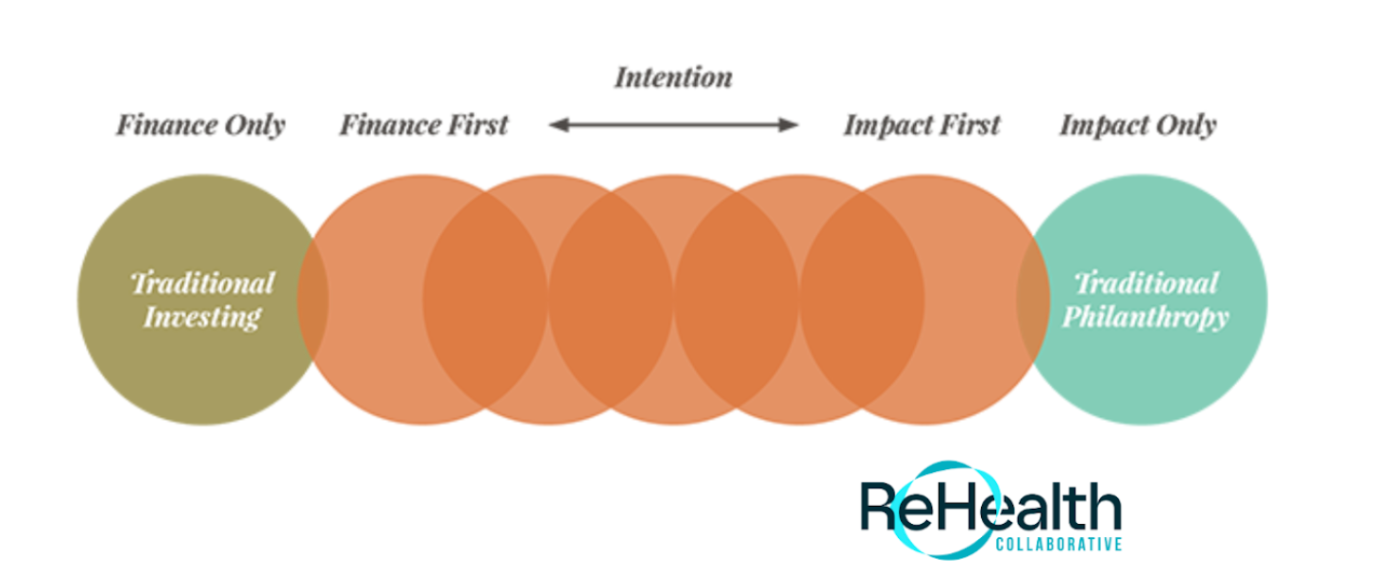
In summary, at ReHealth Collaborative we are building an impact-first portfolio and platform to advance community health solutions that produce societal benefits and that deliver financial returns that can be reinvested.
Why This Matters Now More Than Ever
We can collaborate to lower barriers to capital for community-driven programs that address structural drivers of health.
Through our work we seek to break down persistent barriers including: pace of investment, the capital sequencing puzzle, transaction fragmentation, and the nascent ecosystem.
Pace of Investment
Challenge: The immediacy of the need for community-based programs is often a mis-match for the long-term, routinized funding cycles of foundations, family offices, and government agencies. These lengthy cycles favor established, well-capitalized programs that have resources to fill gaps in between traditional funding cycles. Commercial lenders may also be hesitant to engage smaller nonprofits with a less established balance sheet and credit history or their rates are too high for nonprofits to absorb.
ReFrame: To enable emerging concepts to flourish we must offer quick, flexible capital solutions that provide sufficient funding to start a new program or rapidly scale an existing program.
Capital Sequencing Puzzle
Challenge: CBOs often must piece together funding drawn from a patchwork quilt of sources - individual donors, foundations, private partners or sponsors, government, and potentially lenders. Getting all the pieces to fit together on a similar timeline is a massive feat.
ReFrame: Catalytic investors can and should help bring new investors into a deal on a similar timeframe to help secure a meaningful amount of capital in a single funding round and allow the CBO to focus on program growth and quality.
Transaction Fragmentation
Challenge: There are very few standardized approaches or templates in impact investing. While impact investors are quick to share what worked for them and open playbooks to support others, it still seems that nearly every transaction is bespoke, as if starting from square one.
ReFrame: By the time we identify a program or organization that aligns with our investment criteria and standard deal terms, and know the interest is mutual - but before due diligence - we should ensure that both parties to the transaction are around 25 percent of the way through the funding race, not standing still at the starting line.
Nascent Ecosystem
Challenge: In the private sector there are huge private equity and venture capital ecosystems built up with frameworks, models, templates, and advisors that streamline matchmaking, diligence, and investment transactions. These have been tested and refined over tens of thousands of investments. For all its benefits, the health-focused impact-first investing ecosystem is less established and robust than PE or VC. During our 2025 listening tour with more than 60 organizations we clearly heard the need for community and sharing around this topic.
ReFrame: Build and iteratively improve opportunities for health-focused impact investors to learn, network, co-create, measure, and refine ecosystem frameworks and infrastructure.
What’s Next
Community impact is delivered through deeds, not words.
As we are only two months into our new vision and organizational strategy, we recognize the need to put more capital to work and show the value that impact investing can deliver for community-led health solutions.
In the months ahead, we seek to expand the speed and scale of capital deployment to community-based organizations that address local health related social needs and deliver measurable results.
At ReHealth Collaborative, we aspire to cut in half the time and resources impact investors spend on the full cycle of diligence and deployment of an impact investment to a community-based organization, without sacrificing quality, as measured by social outcomes and capital preservation. Imagine what good we can collectively do if what normally takes us 10 months is reduced down to 10 weeks through efficiency gains!
We will also look to expand the products we offer to better align the form of an investment with organizational needs - e.g., is a loan or a guarantee preferable to our investee? And we will offer greater support for organizational capacity building among investees. We will also look to collaborate more with funders that are looking to build their own impact investing portfolios. With their place- and issue-based knowledge and networks and ReHealth’s impact-first tools and processes, we can serve as a plug-and-play resource for transforming philanthropic capital into strategic impact investments. (In our next blog post we’ll share more about how we plan to recycle capital from our investments.)
We welcome insights and ideas from other impact investors and capital providers on how to make our investment process more efficient and responsive for both parties in the transaction.